
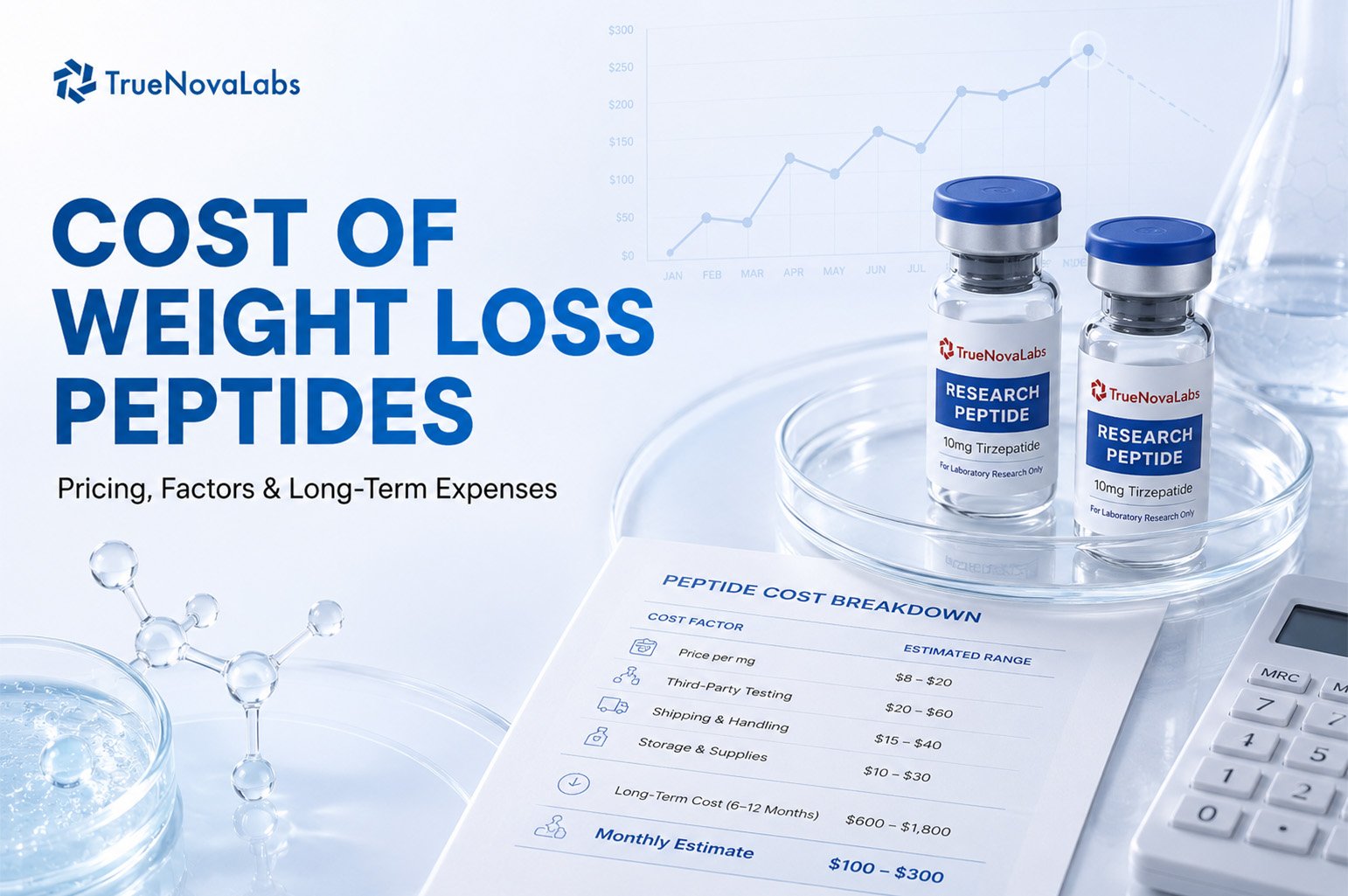
The topic of cost of weight loss peptides is becoming increasingly relevant as interest in metabolic research grows. While many discussions focus on how peptides work, fewer explore the financial side—including pricing variability, long-term expenses, and what actually drives cost differences.
In Canada, this conversation is even more nuanced because it involves both regulated pharmaceutical products and research peptides, which exist in different categories with different pricing structures.
👉 Looking for research-grade peptides with verified purity and transparent sourcing? Explore available options here SHOP ALL COMPOUNDS
This guide breaks down what affects peptide pricing, how costs compare across categories, and what to consider when evaluating long-term value.
What Affects the Cost of Weight Loss Peptides?
Peptide pricing is influenced by a range of scientific, manufacturing, and supply-chain factors rather than being determined arbitrarily.
One of the most important variables is peptide purity. High-quality peptides that undergo analytical verification — including methods such as HPLC testing and batch-specific Certificates of Analysis (COAs) — generally carry higher production costs due to stricter quality-control and validation standards.
Manufacturing complexity is another major factor. Certain peptides require more advanced synthesis processes, particularly compounds with longer amino acid chains, specialized modifications, or structurally complex sequences.
Storage and stability requirements may also affect pricing. Peptides that require controlled storage conditions, such as refrigeration, temperature-sensitive handling, or lyophilized preparation, often involve additional logistical and preservation costs throughout the supply process.
Supplier transparency can further influence overall value and pricing structure. Vendors that provide detailed testing documentation, sourcing information, and batch-level quality data typically maintain higher operational standards, which may be reflected in the final cost of the product.

Average Monthly Pricing Comparison
When evaluating peptide costs, it is important to distinguish between research peptides and regulated pharmaceutical products.
Pharmaceutical GLP-1–based medications, such as Ozempic, are distributed within regulated healthcare systems and are typically subject to prescription requirements, medical oversight, and insurance-related pricing structures in countries such as Canada.
Research peptides operate within a different framework. Their pricing is generally influenced by factors such as:
- supplier quality standards
- purity verification and analytical testing
- formulation strength and concentration
- packaging methods and storage requirements
Because research compounds are not standardized under the same pharmaceutical regulations, pricing may vary substantially between suppliers.
Within this category, cost alone is not the most important consideration. Consistency, product integrity, analytical transparency, and overall reliability are often more critical factors for maintaining dependable research outcomes.
GLP-1 Peptides vs Other Weight Loss Options
GLP-1–related peptides tend to be among the most discussed in weight-related research, but they are not the only category.
Compared to traditional weight loss options—such as stimulant-based products—peptides often reflect a different pricing structure due to:
- their biological complexity
- manufacturing requirements
- storage sensitivity
Traditional fat burners are generally more affordable because they rely on widely available compounds. However, they are also associated with short-term stimulation rather than long-term metabolic signaling.
Peptides, by contrast, are studied for how they influence regulatory systems, which contributes to their higher cost profile.

Hidden Costs and Ongoing Expenses
| Cost Area | What It Includes | Why It Matters |
|---|---|---|
| Repeated Sourcing | Ongoing peptide purchases for extended research periods | Peptides are not typically evaluated as one-time interventions |
| Storage Conditions | Refrigeration, temperature control, and protection from light exposure | Poor storage can affect stability and research reliability |
| Monitoring & Documentation | Tracking study timelines, batch details, and observations | Helps maintain consistency across research periods |
| Reconstitution Materials | Sterile water, bacteriostatic water, syringes, and preparation tools | Required for proper peptide preparation in research settings |
| Lab-Grade Handling Tools | Sterile equipment and clean handling supplies | Helps reduce contamination and preparation errors |
These factors contribute to the overall cost beyond the initial purchase, which is why researchers should consider the full long-term investment involved in peptide research.
Are Expensive Peptides More Effective?
Price alone does not determine effectiveness—but it often correlates with quality control and consistency.
Higher-priced peptides may reflect:
- better purity verification
- more reliable sourcing
- improved stability and handling
However, expensive does not always mean superior. What matters is whether the product:
- provides verifiable testing
- maintains consistency across batches
- is handled and stored correctly
This is why evaluation should focus on data and transparency, not just price.
Cost of weight loss peptides explained. Learn pricing factors, monthly costs, and long-term expenses—plus explore this guide at Peptides for Weight Loss: Benefits, Mechanisms & What to Expect
Ways People Try to Reduce Costs
In research environments, cost management often focuses on efficiency rather than shortcuts.
Some approaches include:
- sourcing from verified suppliers to avoid inconsistencies
- maintaining proper storage to prevent degradation
- ensuring accurate preparation to reduce waste
Cutting costs by compromising on quality can lead to unreliable results, which ultimately increases long-term expense.
👉 For consistent quality and transparent sourcing, explore research peptides here SHOP ALL COMPOUNDS
Learn how appetite suppressant peptides may influence hunger, cravings, and satiety in research—explore related weight loss peptide insights at Peptides for Weight Loss: Benefits, Mechanisms & What to Expect
FAQ – Cost of Weight Loss Peptides
How much do weight loss peptides cost?
Pricing varies widely depending on peptide type, purity, supplier, and whether the product is pharmaceutical or research-grade.
Why are peptides more expensive than fat burners?
Because they involve more complex synthesis, stricter quality control, and greater sensitivity to storage conditions.
Are cheaper peptides lower quality?
Not always, but lack of verification and transparency may increase the risk of inconsistency.
Do peptides require ongoing investment?
Yes. Research typically involves continuous observation and repeated sourcing.
Are peptides regulated in Canada?
Substances are regulated based on classification and intended use by organizations such as Health Canada.
Conclusion
The cost of weight loss peptides is not just about price—it reflects the complexity of the compounds, the quality of sourcing, and the long-term nature of metabolic research.
Understanding this cost structure requires looking beyond initial pricing and considering:
- purity and verification
- storage and handling
- consistency across batches
- long-term research requirements
For researchers in Canada, reliable outcomes depend on balancing cost with quality and transparency.
Explore Research-Grade Peptides
If you’re looking for peptides supported by verified purity, transparent sourcing, and consistent quality standards, explore the full collection here SHOP ALL COMPOUNDS
Disclaimer:
This content is provided by True Nova Labs for educational and research purposes only. It is not intended to diagnose, treat, cure, or prevent any disease, nor to provide medical or legal advice.





3 Comments
Jessica Moore
This article was really helpful for understanding the actual long-term costs behind weight loss peptides. A lot of people only focus on the upfront price, so I appreciated the discussion around ongoing expenses and treatment factors. It definitely gives a more realistic perspective before getting started.
Brandon Lee
Great breakdown of the pricing factors involved. I liked that the article explained why costs can vary so much depending on peptide type, dosage, and treatment duration. It would be interesting to see a future comparison between clinic-based programs and self-managed approaches.
Rachel Turner
Very informative and easy to follow. The section discussing hidden or overlooked expenses was especially valuable because most articles online rarely mention that side of the process. I also appreciate the balanced tone throughout the article.