
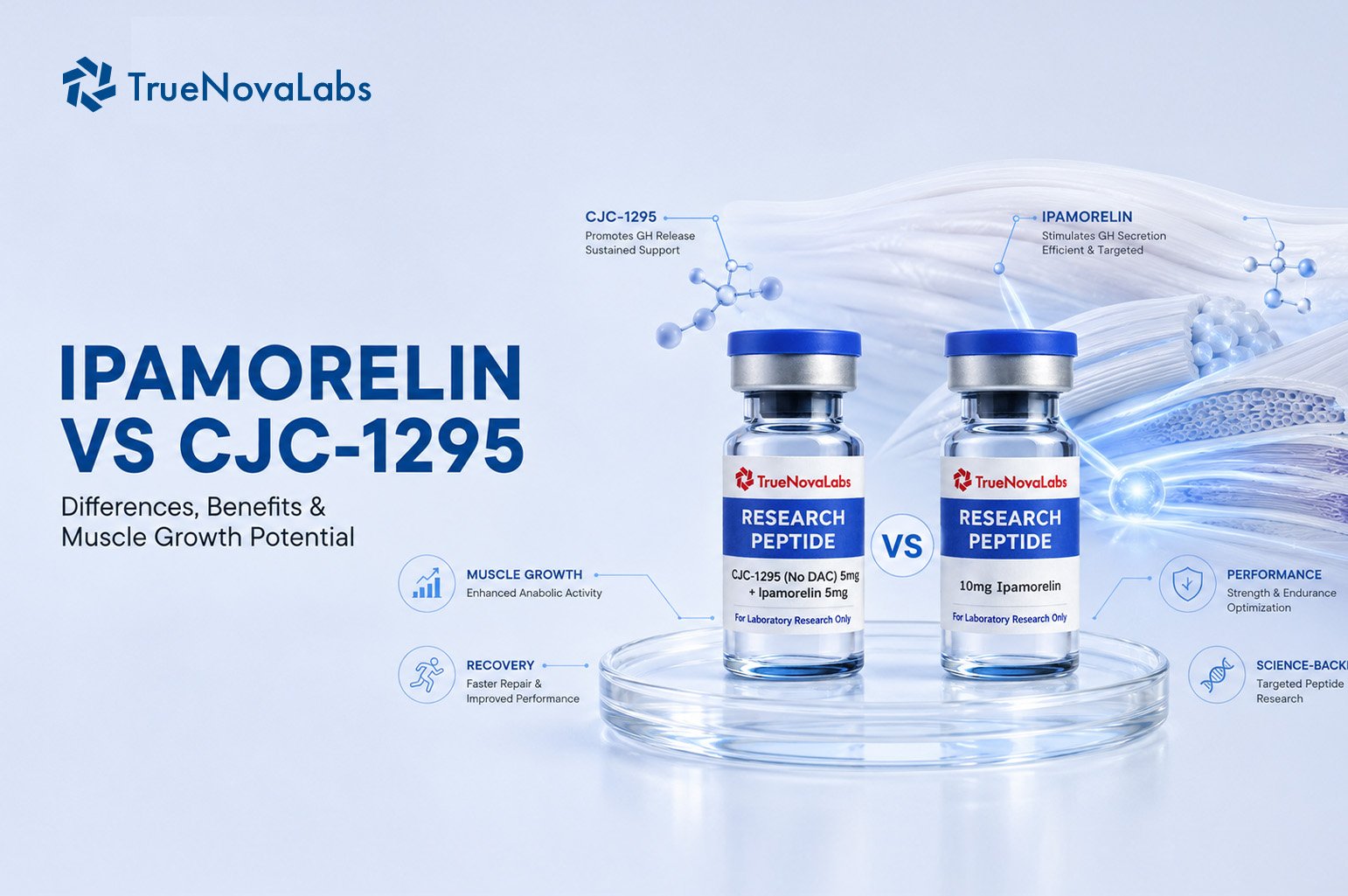
The comparison between Ipamorelin vs CJC-1295 is one of the most common discussions in research related to growth hormone signaling and muscle recovery pathways. While both peptides are studied in the context of performance and adaptation, they function through different mechanisms within the same endocrine system.
Understanding how they differ—and how they may complement each other—requires looking beyond simplified claims and focusing on how the body regulates growth hormone (GH) and recovery over time.
In Canada, peptides like these are typically supplied for laboratory and educational purposes only, not as approved performance-enhancing products.
👉 Looking for research-grade peptides with verified purity and transparent sourcing? Explore available options here SHOP ALL COMPOUNDS
This guide explains how Ipamorelin and CJC-1295 work, how they compare, and what current research suggests about their potential roles in muscle-related studies.
How Ipamorelin Works
Ipamorelin is studied as a growth hormone secretagogue, meaning it stimulates the body’s natural release of growth hormone.
It acts by mimicking ghrelin-related signaling, interacting with receptors that influence GH release from the pituitary gland.
What makes Ipamorelin distinct is its selectivity. It is often discussed for its ability to:
- stimulate GH release without significantly affecting other hormones
- follow more natural pulsatile patterns of GH secretion
- minimize broader endocrine disruption in research models
Because of this, Ipamorelin is frequently associated with studies focusing on:
- recovery efficiency
- sleep-related GH cycles
- tissue repair processes
Its effects are typically evaluated over time, not as immediate performance changes.
How CJC-1295 Works
CJC-1295 works through a different mechanism.
It is a growth hormone–releasing hormone (GHRH) analog, meaning it signals the body to increase GH production by acting upstream in the signaling pathway.
Unlike Ipamorelin, which triggers GH release directly, CJC-1295:
- amplifies the body’s own GH signaling cascade
- supports sustained GH levels over time
- may extend the duration of GH activity depending on formulation
Some forms of CJC-1295 are studied for their longer half-life, which allows for more prolonged signaling effects compared to shorter-acting peptides.
This makes it relevant in research exploring:
- long-term hormonal patterns
- sustained anabolic signaling
- recovery and adaptation cycles

Muscle Growth and Recovery Benefits Compared
From a research perspective, researchers associate both peptides with indirect support of muscle growth, primarily through their influence on GH and IGF-1 pathways.
Ipamorelin is often linked to:
- more natural GH release patterns
- support for recovery cycles
- minimal interference with other hormonal systems
CJC-1295 is more commonly associated with:
- sustained GH signaling
- extended anabolic environment
- long-term adaptation processes
However, neither peptide directly “builds muscle.”
Instead, they are studied for how they may support:
- protein synthesis signaling
- tissue repair
- recovery efficiency
Muscle growth remains dependent on:
- training stimulus
- nutrition
- recovery
Peptides are only one part of that system.
Side Effects and Safety Differences
Because both peptides interact with GH-related pathways, their side effect profiles are often discussed together.
However, differences may arise due to their mechanisms.
Ipamorelin’s selectivity may result in:
- fewer off-target hormonal effects
- more controlled GH release patterns
CJC-1295, due to its broader signaling influence, may introduce:
- more prolonged hormonal activity
- variability depending on formulation and half-life
In both cases, risks are often linked not just to the peptide itself, but to:
- purity and quality
- improper storage
- contamination during preparation
- inconsistent sourcing
Peptides are sensitive molecules, and degradation can alter their behavior.
In Canada, substances are regulated based on classification and intended use by organizations such as Health Canada, reinforcing the importance of proper context.
👉 For consistent quality and verified sourcing, explore research peptides here SHOP ALL COMPOUNDS
Stacking Ipamorelin With CJC-1295
One of the reasons these peptides are often compared is because they are also studied together in combination.
From a research standpoint, stacking is based on the idea that:
- CJC-1295 enhances GH signaling upstream
- Ipamorelin triggers GH release downstream
This complementary interaction may create a more coordinated GH response pattern, which is why it is frequently explored in studies related to:
- recovery
- adaptation
- hormonal regulation
However, stacking also increases complexity, requiring careful control of:
- dosing parameters
- timing
- study conditions
👉 For consistent quality and verified sourcing, explore research peptides here SHOP ALL COMPOUNDS
Which Peptide Fits Different Goals?
Choosing between Ipamorelin and CJC-1295 depends on the research objective.
If the focus is on:
- natural GH release patterns
- recovery and sleep-related signaling
- minimal endocrine disruption
Ipamorelin may be more relevant.
If the focus is on:
- sustained GH signaling
- long-term hormonal adaptation
- extended anabolic environment
CJC-1295 may be more aligned.
In many cases, researchers study both peptides individually and in combination to better understand how they may modulate GH signaling.
Ipamorelin vs CJC-1295 explained. Compare mechanisms, muscle growth potential, and safety—read more in our guide: Peptides for Muscle Growth: Benefits, Performance & What to Expect
FAQ – Ipamorelin vs CJC-1295
What is the main difference between Ipamorelin and CJC-1295?
Ipamorelin stimulates GH release directly, while CJC-1295 enhances upstream GH signaling.
Do these peptides build muscle directly?
No. They are studied for how they influence recovery and hormonal pathways that support muscle growth.
Can they be used together?
They are often studied together due to their complementary mechanisms.
Which is better for recovery?
Both are associated with recovery pathways, but through different mechanisms.
Are these peptides approved in Canada?
Regulators classify most of them as research peptides, and pharmaceutical frameworks must regulate them before they qualify as approved therapeutic products.
Conclusion
The comparison of Ipamorelin vs CJC-1295 highlights how muscle growth research is evolving toward understanding hormonal signaling rather than isolated outcomes.
While both peptides interact with GH pathways, they do so at different points in the signaling cascade.
Ipamorelin emphasizes precision and natural release, while CJC-1295 focuses on amplification and duration.
Understanding these differences allows for more accurate interpretation of research and more realistic expectations.
Explore Research-Grade Peptides
If you’re looking for peptides supported by verified purity, transparent sourcing, and consistent quality standards, explore the full collection here SHOP ALL COMPOUNDS
Disclaimer:
This content is provided by True Nova Labs for educational and research purposes only. It is not intended to diagnose, treat, cure, or prevent any disease, nor to provide medical or legal advice.




3 Comments
Brandon Hayes
Really informative comparison between Ipamorelin and CJC-1295. I liked how the article explained the difference between growth hormone signaling and pulse stimulation instead of making the two peptides sound interchangeable. The section about recovery and muscle growth potential was especially helpful.
Natalie Brooks
Great read overall. There’s a lot of conflicting information online about stacking these peptides, so I appreciated the balanced explanation around how they may work differently and why some people combine them. It would be interesting to see a deeper article comparing recovery-focused outcomes versus physique-focused goals.
Tyler Morgan
Very well structured and easy to follow. I appreciate that the article discussed realistic expectations around muscle growth and recovery instead of overhyping results. The explanation about how these peptides influence natural GH release made the topic much easier to understand.