

Interest in peptides for muscle growth has expanded as research continues to explore how the body regulates recovery, protein synthesis, and hormonal signaling. Rather than acting like traditional stimulants or supplements, peptides are studied for how they influence cellular communication and endocrine pathways involved in muscle adaptation.
Muscle growth itself is not a single process. It depends on a combination of:
- training stimulus
- recovery capacity
- protein synthesis
- hormonal balance
Peptides are being researched as one part of this system—not as standalone drivers of performance.
In Canada, many peptides discussed in this space are supplied strictly for laboratory and educational purposes only, not as approved performance-enhancing products.
👉 Looking for research-grade peptides with verified purity and transparent sourcing? Explore available options here SHOP ALL COMPOUNDS
This guide explains how muscle growth peptides are studied, which compounds are commonly discussed, and what current research suggests about their potential and limitations.
How Muscle Growth Peptides Work
Muscle growth peptides are studied for how they interact with signaling pathways that influence recovery and adaptation.
Many of these peptides are associated with:
- growth hormone (GH) signaling
- IGF-1 (insulin-like growth factor-1) pathways
- cellular repair mechanisms
- protein synthesis regulation
Rather than directly building muscle, they are explored for how they may support the conditions required for muscle development.
For example, peptides that influence GH release may affect:
- recovery speed
- tissue repair
- overall anabolic signaling
This indirect mechanism is important. Muscle growth is the result of repeated adaptation over time, not a single intervention.

Most Popular Peptides for Building Muscle
Researchers frequently discuss several peptides in muscle growth-related research.
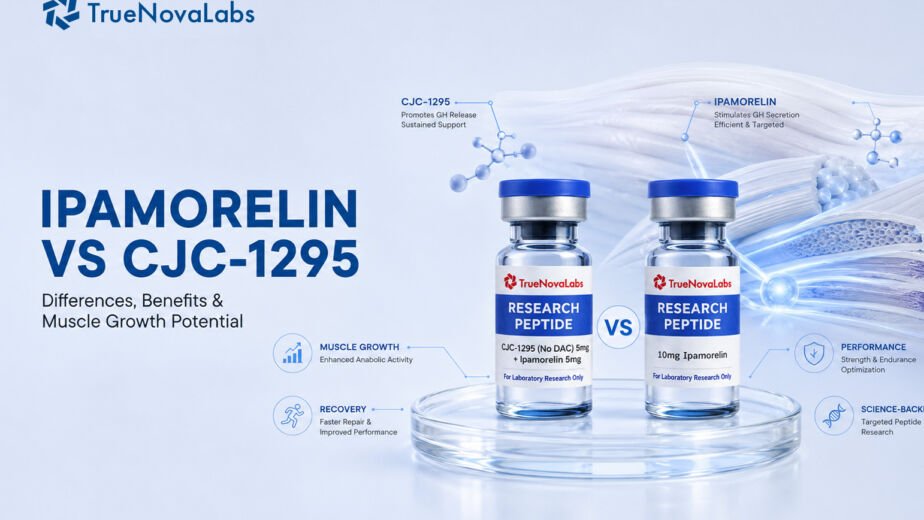
Researchers commonly associate CJC-1295 and Ipamorelin with growth hormone–related pathways. In particular, they are studied for how they may influence endogenous GH release.
BPC-157 is often explored in tissue repair and recovery models, particularly in relation to muscle and tendon research.
TB-500 is studied for its connection to actin and cell migration, which are important in recovery and repair processes.
These peptides differ in mechanism. Some focus on hormonal signaling, while others are associated with cellular repair and recovery.
Muscle Growth vs Strength Gains Explained
One of the most common misconceptions is treating muscle growth and strength as the same outcome.
Muscle growth refers to hypertrophy, or the increase in muscle size. Strength, on the other hand, depends on:
- neural adaptation
- coordination
- muscle efficiency
Researchers more often associate peptides studied in this field with recovery and adaptation pathways. As a result, these pathways may indirectly support muscle growth.
However, many additional factors beyond muscle size alone influence strength gains.
Benefits and Performance Potential
| Aspect | Muscle Growth Peptides in Research Context |
|---|---|
| Key Biological Processes Studied | Recovery efficiency, tissue repair processes, consistency in training adaptation, and hormonal signaling related to growth |
| Impact on Performance | May contribute to improved performance over time, but not immediate or guaranteed outcomes |
| Key Limitation | Do not replace structured training, proper nutrition, or adequate recovery |
| Research Role | Studied as one component within a larger performance and adaptation system |
| Expectation Setting | Results are gradual and depend on multiple interacting factors rather than a single compound |
Risks, Side Effects & Recovery Considerations
Because peptides are biologically active compounds, researchers may also observe unintended responses depending on:
- purity and quality
- dosage and study design
- storage and handling
- biological variability
Common concerns in research environments often relate to:
- contamination during preparation
- degradation from improper storage
- inconsistent product quality
Recovery-related peptides may also influence how the body responds to stress and repair cycles, which requires careful interpretation.
In Canada, organizations such as Health Canada regulate substances based on classification and intended use, which reinforces the importance of proper context.
👉 For consistent quality and verified sourcing, explore research peptides here SHOP ALL COMPOUNDS

Who Uses Muscle Growth Peptides?
From a research standpoint, these peptides are relevant in studies focused on:
- muscle recovery models
- tissue repair pathways
- endocrine signaling
- performance adaptation
They are not intended for casual or unsupervised use.
Understanding their role requires focusing on mechanism and system interaction, rather than expecting immediate results.
FAQ – Peptides for Muscle Growth
Do peptides directly build muscle?
No. They are studied for how they influence recovery and signaling pathways that may support muscle growth.
What are the most common peptides for muscle research?
CJC-1295, Ipamorelin, BPC-157, and TB-500 are frequently discussed.
Do peptides increase strength?
Strength gains depend on multiple factors, including neural adaptation and training, not just muscle size.
Are muscle growth peptides safe?
Safety depends on quality, handling, and research conditions.
Are these peptides approved in Canada?
Regulators classify many of these compounds as research peptides, and pharmaceutical frameworks must regulate them before they qualify as approved therapeutic products.
Conclusion
The study of peptides for muscle growth reflects a deeper understanding of how the body adapts to stress, training, and recovery. Rather than acting as direct muscle-building agents, these compounds are explored for how they influence:
- hormonal signaling
- tissue repair
- recovery efficiency
- long-term adaptation
Muscle growth is a gradual process shaped by multiple variables. Peptides are just one piece of that system.
For researchers in Canada, reliable outcomes depend on:
- high-quality sourcing
- proper storage and handling
- understanding of biological pathways
- realistic expectations
Explore Research-Grade Peptides
If you’re looking for peptides supported by verified purity, transparent sourcing, and consistent quality standards, explore the full collection here SHOP ALL COMPOUNDS
Disclaimer:
This content is provided by True Nova Labs for educational and research purposes only. It is not intended to diagnose, treat, cure, or prevent any disease, nor to provide medical or legal advice.



4 Comments
Marcus Hill
Really solid overview of muscle growth peptides and what people can realistically expect from them. I liked that the article focused on recovery, training adaptation, and long-term consistency instead of making exaggerated promises about instant muscle gain. That made the information feel much more credible and practical.
Kaitlyn Reed
Great read overall. The explanation around how peptides may support recovery and hormonal signaling was especially interesting because most articles online oversimplify the topic. I also appreciate that you emphasized the importance of proper training and nutrition alongside peptide research.
Trevor Collins
Very informative and balanced article. I liked that the content discussed realistic timelines and expectations instead of treating peptides like a shortcut to muscle growth. It would be interesting to see a future article comparing recovery-focused peptides versus performance-focused options in more detail.